#include <pipecat/smallwebrtc/transport.h>
Public Member Functions | |
| SmallWebRTCTransport (SmallWebRTCTransportOptions options={}) | |
| Creates a transport. | |
| ~SmallWebRTCTransport () override | |
| Disconnects if needed. | |
| SmallWebRTCTransport (const SmallWebRTCTransport &)=delete | |
| Transports can't be copied. | |
| SmallWebRTCTransport & | operator= (const SmallWebRTCTransport &)=delete |
| Transports can't be copied. | |
| void | initialize (TransportObserver *observer) override |
| Prepares the transport. | |
| void | set_start_bot_params (const APIRequest &request) override |
| void | connect (const nlohmann::json ¶ms) override |
| void | disconnect () override |
| Closes the connection. | |
| void | send_ready_message (const rtvi::Message &message) override |
Sends the client-ready message. | |
| void | send_message (const rtvi::Message &message) override |
| Sends a message to the bot. | |
| int32_t | send_user_audio (const int16_t *frames, size_t num_frames) override |
| int32_t | read_bot_audio (int16_t *frames, size_t num_frames) override |
 Public Member Functions inherited from pipecat::Transport | |
| virtual size_t | max_message_size () const |
| The largest message, in bytes, that send_message() accepts. | |
Detailed Description
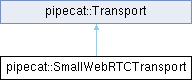
Connects to Pipecat bots over WebRTC, peer to peer, with Pipecat's SmallWebRTC transport.
Give it to PipecatClientOptions::transport. To connect, it sends a WebRTC offer to the bot's server. With PipecatClient::start_bot(), it finds out where on its own: start endpoints like Pipecat's development runner (python bot.py -t webrtc) and Pipecat Cloud answer with a session ID when asked for the webrtc transport. Without it, give it the offer endpoint, see connect().
You can use several at the same time, e.g. one per client to talk to several bots.
Member Function Documentation
◆ connect()
|
overridevirtual |
Connects to the bot.
params says where to send the offer, with one of:
sessionId: the session a start endpoint created, after PipecatClient::start_bot(). The offer goes to the start endpoint's URL, with/startat the end of its path replaced by/sessions/<sessionId>/api/offer, and with the same headers.webrtcRequestParams: the offer endpoint, as a JSON object with its URL inendpoint, and optionally HTTP headers inheadersand data for the bot inrequestData.
If both are there, webrtcRequestParams is used. Optionally, iceConfig has STUN and TURN servers in iceServers, each with its URLs in urls, and username and credential for TURN. Every key can also be in snake case, e.g. session_id.
Throws InvalidTransportParamsError if the params are wrong, and TransportStartError if connecting fails.
Implements pipecat::Transport.
◆ disconnect()
|
overridevirtual |
Closes the connection.
Implements pipecat::Transport.
◆ initialize()
|
overridevirtual |
Prepares the transport.
Implements pipecat::Transport.
◆ read_bot_audio()
|
overridevirtual |
Reads num_frames frames of 16-bit PCM bot audio into frames, converted to the format of the options. Waits until it's time to play them, or until the transport disconnects. Returns the number of frames read, or 0 if it disconnected.
The bot's audio plays at the pace the bot sent it, 80 ms behind, so the network's ups and downs don't reach your app: audio that arrives late or out of order still plays in its turn, and lost audio is concealed. Read it from your audio thread, as you play it.
Implements pipecat::Transport.
◆ send_message()
|
overridevirtual |
Sends a message to the bot.
Implements pipecat::Transport.
◆ send_ready_message()
|
overridevirtual |
Sends the client-ready message.
Implements pipecat::Transport.
◆ send_user_audio()
|
overridevirtual |
Sends num_frames frames of 16-bit PCM user audio, in the format of the options. Returns the number of frames sent.
Send the audio continuously, as it's captured, and send silence while the user is muted: the bot needs it to tell when the user stops speaking. The audio is sent as is, without echo cancellation, and in mono, which is what the bot listens to.
Implements pipecat::Transport.
◆ set_start_bot_params()
|
overridevirtual |
Keeps the request that started the bot, to send the offer to the same server.
Reimplemented from pipecat::Transport.
The documentation for this class was generated from the following file:
- pipecat/smallwebrtc/transport.h